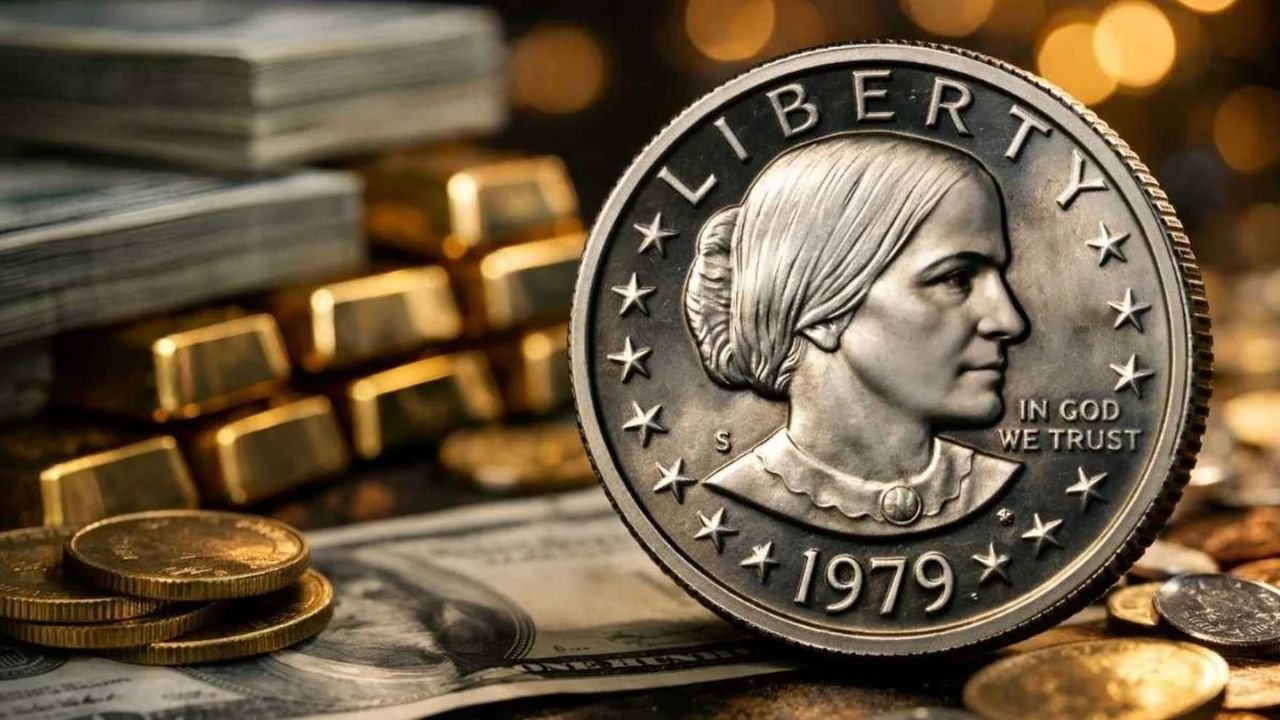
The 1979 Susan B. Anthony Dollar stands as one of the most distinctive and historically meaningful coins in modern American numismatics. Introduced at a time of social and economic transition, it marked a defining moment by honoring Susan B. Anthony—a pioneer of the women’s rights movement—making it the first U.S. circulating coin to feature a real woman rather than an allegorical figure.
While the coin struggled in everyday use, its legacy has only grown stronger among collectors. In 2026, certain rare varieties and error coins from the 1979 issue are gaining renewed attention, with values climbing steadily in high-grade and scarce forms.
The Historical Significance Behind the Coin
The Susan B. Anthony Dollar was introduced as part of a broader effort to modernize U.S. currency and reduce reliance on paper dollar bills. Designed by Frank Gasparro, the coin features a bold portrait of Anthony on the obverse and an eagle landing on the moon on the reverse—a design inspired by the Apollo 11 mission.
Despite its symbolic importance, the coin faced immediate challenges. Its size and color closely resembled the quarter, leading to widespread confusion in circulation. As a result, public adoption was limited, and production ceased after 1981, with a brief revival in 1999.
Ironically, what once made the coin unpopular has contributed to its collectible appeal today.
Why the 1979 Issue Matters Most
Among all Susan B. Anthony Dollars, the 1979 release is particularly important. As the inaugural year, it saw the highest production numbers and introduced key varieties that collectors continue to pursue.
Coins were minted at three primary locations:
Philadelphia (no mint mark)
Denver (D mint mark)
San Francisco (S mint mark, including proof coins)
While millions of coins were produced, not all are created equal. Subtle differences in mint marks, strike quality, and finishing have created a hierarchy of rarity and value.
Key Varieties That Drive Value
1979-S Type 1 vs. Type 2 Proof Coins
The most famous and valuable distinction lies in the San Francisco proof coins.
Type 1 (“Filled S”): The mint mark appears blob-like and less defined.
Type 2 (“Clear S”): The mint mark is sharp, crisp, and more refined.
The Type 2 variety is significantly rarer and highly sought after. In today’s market, well-preserved examples can command premium prices, especially in certified high grades.
High-Grade Uncirculated Coins
Although common in lower grades, coins graded MS65 or higher by professional grading services become much scarcer. These pristine examples often exhibit strong luster, minimal contact marks, and exceptional eye appeal.
Error Coins: Hidden Treasures
Error coins add an extra layer of excitement for collectors. The 1979 Susan B. Anthony Dollar has produced several notable minting anomalies.
Off-center strikes
Doubled die errors
Wrong planchet strikes
Clipped planchets
These errors are rare by nature and can significantly increase a coin’s value. In some cases, dramatic errors with strong visual impact have sold for hundreds or even thousands of dollars, depending on condition and uniqueness.
2026 Value Overview
The value of a 1979 Susan B. Anthony Dollar depends heavily on its condition, rarity, and variety.
Circulated Coins
Typically worth face value ($1)
Minimal collector demand unless part of a complete set
Uncirculated Coins
Range: $2 to $10+
Higher grades command stronger premiums
Proof Coins
Range: $10 to $20+
Type 2 proofs can reach $50 to $100 or more
Error Coins
Range: $100 to several thousand dollars
Depends on rarity, visibility, and collector demand
It’s important to note that professionally graded coins often achieve higher prices due to verified authenticity and condition.
Smart Collecting Strategies
Focus on Quality Over Quantity
Rather than accumulating large numbers of common coins, experienced collectors prioritize fewer, high-quality pieces. Look for coins with strong strikes, clean surfaces, and minimal wear.
Protect and Preserve
Proper storage is essential. Use airtight holders, coin albums or slabs, and low-humidity environments. Proof coins should ideally remain in their original packaging to maintain value.
Certification Matters
Having your coin graded by a reputable service adds credibility and can significantly boost resale value. It also provides peace of mind for buyers and investors.
Investment Potential in 2026 and Beyond
While not every 1979 Susan B. Anthony Dollar will yield substantial returns, the series offers solid long-term potential. Its historical importance, combined with growing interest in modern collectibles, positions it as a stable entry point for both beginners and seasoned investors.
Key factors driving future value include increasing demand for rare varieties, limited supply of high-grade examples, and rising popularity of women-themed historical collectibles.
As more collectors enter the market, competition for premium coins is expected to intensify.
Final Thoughts
The 1979 Susan B. Anthony Dollar is far more than a short-lived experiment in U.S. currency—it’s a symbol of progress, innovation, and history. While many examples remain common, the rare varieties, pristine specimens, and striking errors continue to captivate collectors worldwide.
For those willing to look closely and invest wisely, this coin offers more than just historical significance—it offers the thrill of discovery and the potential for meaningful value.